Professional graphite material supplier, graphite for EV, grease, furnace and any other industries.

Sodium-Ion Batteries Become a New Option for the Energy Industry
With the rapid growth of electric vehicles, renewable energy storage systems, and clean energy technologies, concerns over lithium resource supply, raw material costs, and supply chain stability have become increasingly important. As one of the promising alternatives to lithium-ion batteries, sodium-ion batteries (Sodium-ion Battery) are attracting significant attention in European and American markets due to their advantages, including abundant resources, lower cost, improved safety, and environmental benefits.
In recent years, Europe and the United States have accelerated the development of diversified battery technologies to strengthen their energy security and reduce dependence on traditional battery supply chains. Although lithium-ion batteries remain the dominant technology today, sodium-ion batteries are gradually demonstrating strong potential in energy storage, electric vehicles, and cost-sensitive applications.
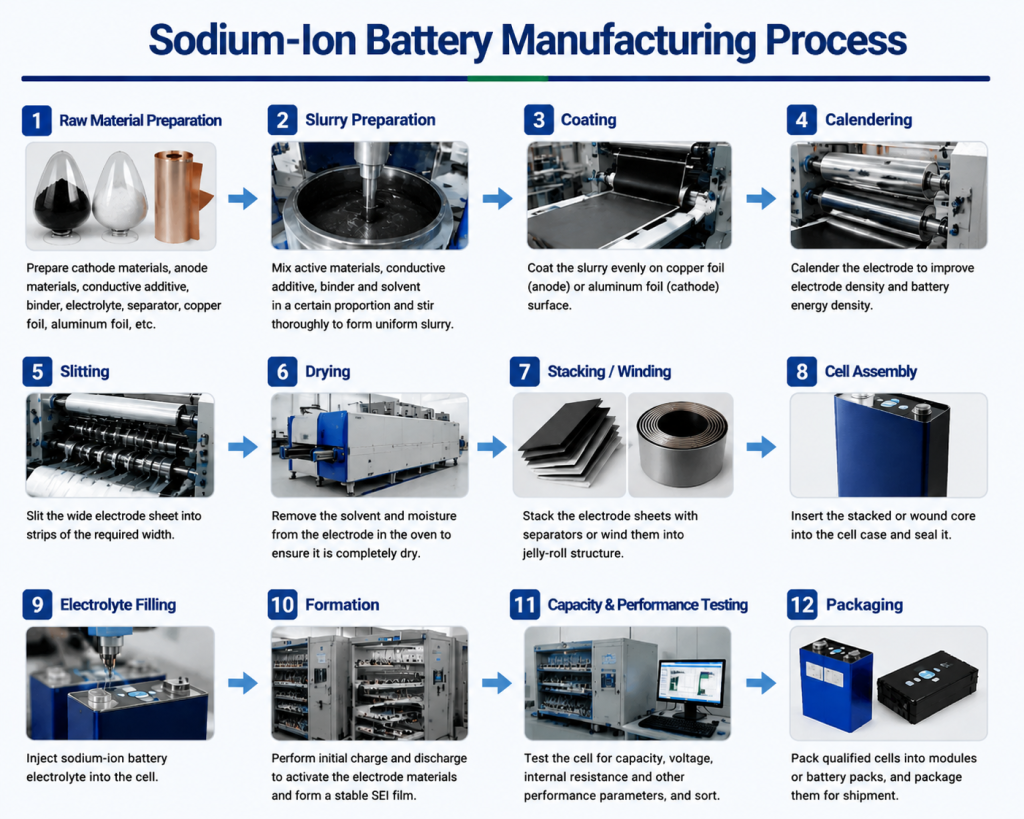
1. Growing Attention Toward Sodium-Ion Batteries in European and American Markets
Currently, the development of the new energy industry in Europe and the United States is primarily focused on two areas: transportation electrification and large-scale renewable energy storage.
In the electric vehicle sector, European and American markets have traditionally relied heavily on lithium-ion batteries, especially lithium iron phosphate (LFP) batteries and ternary lithium batteries. However, fluctuations in lithium, nickel, and cobalt prices, combined with concerns about supply chain security, have encouraged companies to explore alternative battery technologies.
Sodium resources are much more abundant than lithium resources and are widely distributed around the world. Therefore, sodium-ion batteries are considered a promising solution for reducing battery manufacturing costs and improving supply chain stability.
In Europe, many countries are actively developing local battery manufacturing capabilities to reduce dependence on Asian battery supply chains. Sodium-ion battery technology has become one of the important next-generation battery solutions being explored by European battery companies.
In the United States, driven by policies such as the Inflation Reduction Act (IRA), domestic clean energy manufacturing has received strong support. As a result, sodium-ion batteries are gaining attention, particularly for stationary energy storage applications.
2. Main Application Areas of Sodium-Ion Batteries in Europe and the United States
2.1 Large-Scale Energy Storage as the Primary Growth Opportunity
Currently, energy storage systems represent one of the most promising application areas for sodium-ion batteries.
Because renewable energy sources such as solar and wind power are intermittent, the demand for large-scale energy storage solutions is increasing rapidly. Compared with electric vehicles, energy storage applications have relatively lower requirements for energy density but place greater emphasis on:
- Long cycle life;
- High safety;
- Low manufacturing cost;
- Stable raw material supply.
Sodium-ion batteries offer advantages in these areas.
Unlike lithium-ion batteries, sodium-ion batteries do not rely on expensive metals such as lithium, cobalt, and nickel. This helps reduce the overall cost of energy storage systems. In addition, sodium-ion batteries generally provide good low-temperature performance and safety characteristics, making them suitable for energy storage projects in colder regions of Europe and North America.
2.2 Gradual Exploration in Electric Vehicle Applications
Although sodium-ion batteries currently have lower energy density compared with advanced lithium-ion batteries, continuous improvements in materials and manufacturing technologies are helping enhance their performance.
Current commercial sodium-ion batteries typically achieve energy densities of approximately 100-160 Wh/kg, while next-generation products are expected to approach or exceed 180 Wh/kg.
In European and American markets, sodium-ion batteries may initially be applied in:
- Urban short-range electric vehicles;
- Two-wheel electric vehicles;
- Low-speed vehicles;
- Entry-level passenger cars.
For these applications, cost, safety, and durability are often more important than maximum driving range, providing sodium-ion batteries with significant market opportunities.
3. Development of the Sodium-Ion Battery Supply Chain in Europe and the United States
European and American companies are actively developing sodium-ion battery supply chains, including cathode materials, anode materials, battery manufacturing, and energy storage system integration.
Key sodium-ion battery materials include:
- Layered oxide cathode materials;
- Polyanionic cathode materials (such as NFPP);
- Prussian blue-based cathode materials;
- Hard carbon anode materials.
Among these materials, hard carbon anode materials are considered one of the most important components for sodium-ion battery commercialization. Compared with traditional graphite anodes, hard carbon provides better sodium-ion storage capability, higher specific capacity, and improved cycling performance.
As Europe and the United States continue to strengthen domestic battery production, advanced hard carbon materials, sodium-ion cathode materials, and related manufacturing technologies are expected to receive increasing investment and market attention.
4. Challenges Facing Sodium-Ion Batteries in European and American Markets
Despite their promising prospects, sodium-ion batteries still face several challenges before achieving large-scale commercialization.
First, energy density remains lower than that of advanced lithium-ion batteries. High-performance electric vehicles still mainly rely on high-nickel ternary lithium batteries or lithium iron phosphate batteries.
Second, the sodium-ion battery supply chain is still in the early stages of development. Compared with mature lithium-ion battery manufacturing systems, large-scale production capacity remains limited.
In addition, market acceptance is another challenge. European and American customers typically require extensive validation of new battery technologies, including:
- Cycle life testing;
- Safety evaluation;
- Environmental adaptability testing;
- Large-scale application verification.
5. Future Outlook of Sodium-Ion Batteries in European and American Markets
Over the next 5-10 years, sodium-ion batteries are expected to play an increasingly important role in European and American energy markets.
Short Term (1-3 Years)
Sodium-ion batteries are expected to enter energy storage markets and selected low-cost electric vehicle applications.
Medium Term (3-5 Years)
With improvements in material technology and expanded production capacity, sodium-ion batteries are expected to further demonstrate cost advantages and become an important supplement to lithium-ion batteries.
Long Term (5+ Years)
Sodium-ion batteries are likely to establish a complementary relationship with lithium-ion batteries:
- Lithium-ion batteries will continue dominating high-energy-density applications;
- Sodium-ion batteries will focus on large-scale energy storage and cost-sensitive markets.
Sodium-Ion Batteries Will Play an Important Role in Future Energy Markets
Overall, sodium-ion batteries are still in the early commercialization stage in European and American markets, but their future potential has attracted significant industry attention. With advantages including abundant resources, lower costs, improved safety, and suitability for energy storage applications, sodium-ion batteries are becoming one of the most important alternative battery technologies.
As Europe and the United States continue promoting energy transition, domestic battery manufacturing, and renewable energy development, sodium-ion batteries are expected to become increasingly important in the global battery industry and contribute to a more diversified and sustainable energy future.
Graphite-Corp is an advanced materials manufacturer dedicated to the R&D, production, and sales of lithium-ion battery anode materials. Our current product portfolio includes artificial graphite anode materials, silicon-carbon and silicon-oxide anode materials, and porous carbon materials for silicon-carbon applications. Please feel free to contact us regarding your requirements; we look forward to serving you.
RELATED POSTS

Graphite Guild: Profiling the Professionals Engaged in Working with this Carbon Material.

Silicon Monoxide Formula

What is flake graphite?

How To Put Graphite On Pinewood Derby Wheels
How To Tell Whether You Should Use Steel Or Graphite Shafts