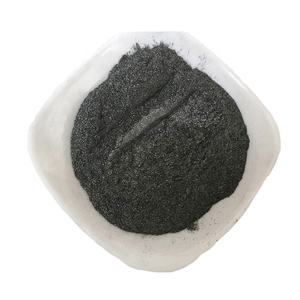
Professional graphite material supplier, graphite for EV, grease, furnace and any other industries.

Graphite is one of the most important anode materials in lithium-ion batteries (LIBs). Due to its excellent electrical conductivity, stable layered structure, relatively low operating potential, and outstanding cycling performance, graphite has become the dominant commercial anode material in the lithium-ion battery industry. It is widely used in electric vehicles (EVs), consumer electronics, power tools, and large-scale energy storage systems.
As the global demand for lithium-ion batteries continues to grow, the application and development of graphite in lithium batteries are becoming increasingly important. Manufacturers are continuously improving graphite anode materials to enhance energy density, charging speed, cycle life, and safety while reducing production costs.
This article explores the application of graphite in lithium-ion batteries, its major advantages, different types of graphite anode materials, manufacturing technologies, and future development trends.
1. What Is Graphite in Lithium-Ion Batteries?
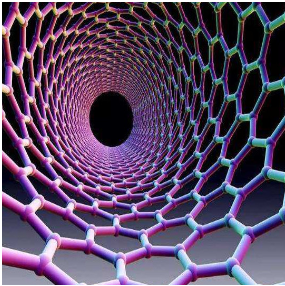
Graphite is a crystalline carbon material characterized by a layered structure. Each layer consists of carbon atoms arranged in a hexagonal lattice, while relatively weak forces exist between adjacent layers.
This unique structure allows lithium ions to intercalate between graphite layers during battery charging and deintercalate during discharging.
In a lithium-ion battery, graphite typically serves as the negative electrode (anode). During charging, lithium ions migrate from the cathode through the electrolyte and enter the graphite structure. During discharging, lithium ions leave the graphite anode and return to the cathode, generating electrical energy.
The theoretical specific capacity of graphite is approximately 372 mAh/g, corresponding to the formation of LiC₆. Although this capacity is lower than that of silicon-based anode materials, graphite offers excellent stability and mature manufacturing technology.
These characteristics make graphite an essential material for commercial lithium-ion batteries.
2.Major Applications of Graphite in Lithium Batteries
2.1 Graphite Anode Materials for Electric Vehicles
Electric vehicles are one of the largest application markets for graphite anode materials. EV batteries require high energy density, long cycle life, fast charging capability, and reliable safety performance.
Artificial graphite is widely used in electric vehicle batteries because of its consistent material properties, controlled particle morphology, and excellent electrochemical performance.
Graphite anode materials can help improve battery stability and support long-term charging and discharging operations. In addition, graphite-based anodes are compatible with established lithium-ion battery manufacturing processes.
As the electric vehicle industry develops, high-performance graphite anode materials are becoming increasingly important for improving driving range and battery durability.
2.2 Graphite for Energy Storage Systems
Lithium-ion batteries are widely used in residential, commercial, industrial, and utility-scale energy storage systems.
In these applications, batteries often undergo frequent charging and discharging cycles. Therefore, graphite anode materials must provide excellent cycling stability, low degradation, and reliable performance.
Artificial graphite is commonly selected for energy storage batteries due to its controllable properties and suitability for long-life battery systems.
The continued expansion of renewable energy, including solar and wind power, is expected to increase demand for graphite anode materials used in energy storage applications.
2.3 Graphite in Consumer Electronics
Graphite anode materials are also extensively used in smartphones, laptops, tablets, wearable devices, and other portable electronic products.
Consumer electronics require batteries with high energy density, compact dimensions, and stable performance.
Graphite provides a favorable balance between capacity, electrochemical stability, and cost, making it suitable for these applications.
With the development of high-performance electronic devices, graphite anode materials with improved compacted density and optimized particle size distribution are attracting increasing attention.
3. Natural Graphite vs. Artificial Graphite in Lithium Batteries
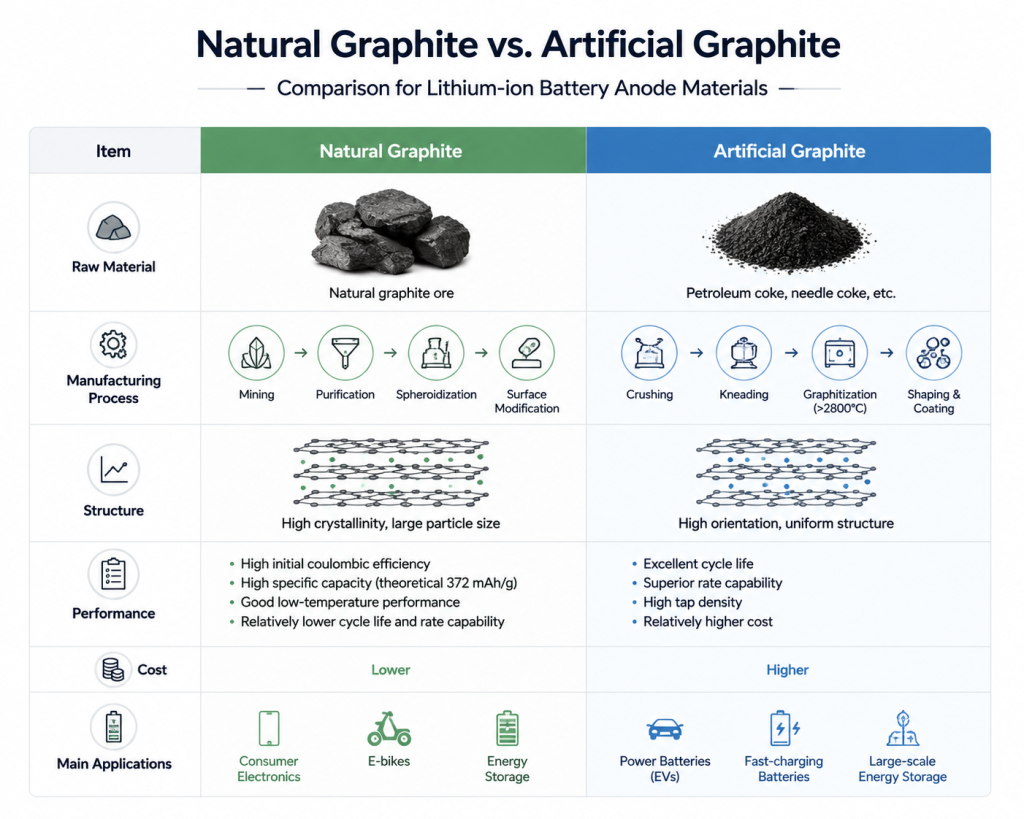
Graphite anode materials are mainly classified into two categories: natural graphite and artificial graphite. Both materials are widely used in lithium-ion batteries, but they differ in production methods, material properties, and application characteristics.
| Comparison | Natural Graphite | Artificial Graphite |
|---|---|---|
| Raw materials | Natural graphite ore | Petroleum coke, needle coke |
| Production process | Purification, spheroidization, surface coating | Carbonization, graphitization |
| Production cost | Generally lower | Generally higher |
| Material consistency | Depends on ore and processing | Highly controllable |
| Electrical conductivity | Excellent | Excellent |
| Cycle performance | Good | Generally excellent |
| Applications | Consumer electronics, EVs | EVs, power batteries, energy storage |
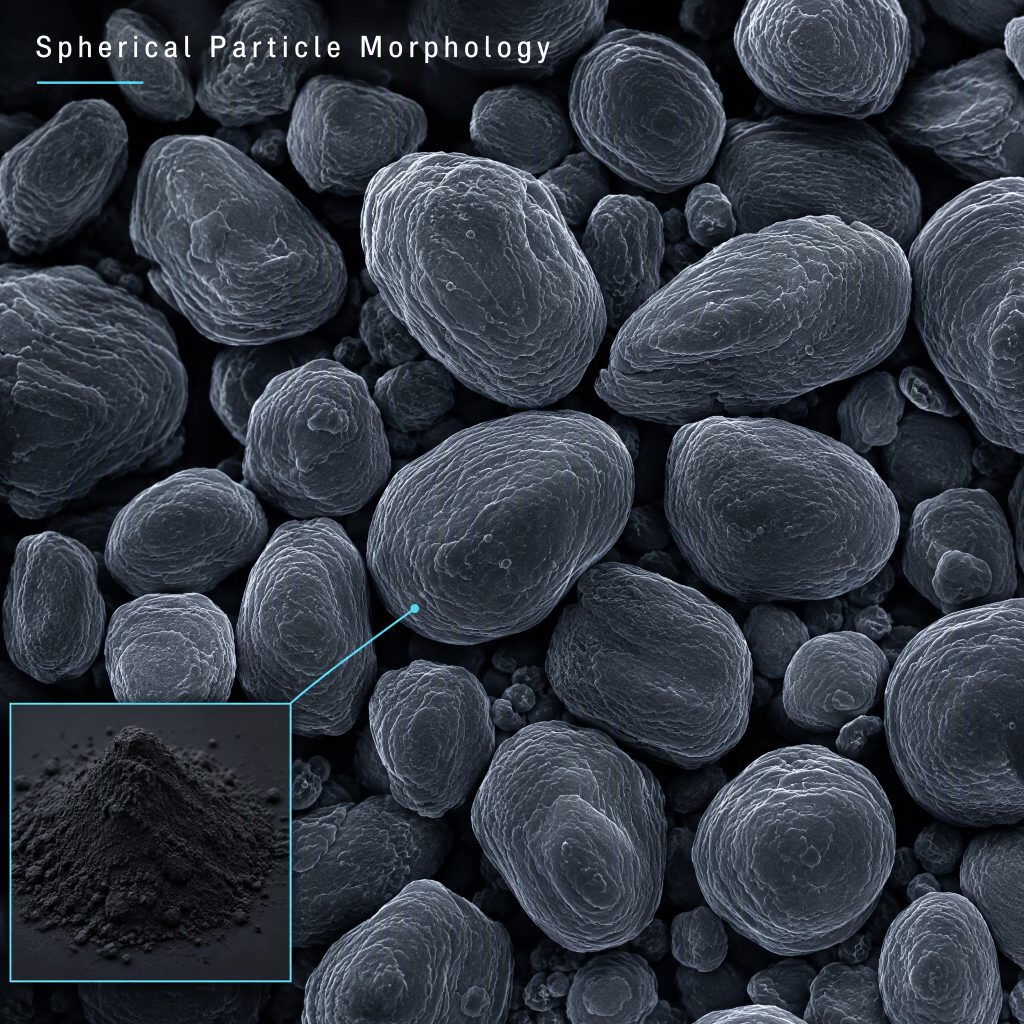
Natural graphite is attractive because of its relatively low cost and high theoretical capacity. Through spheroidization and surface coating, natural graphite can achieve improved particle morphology and electrochemical performance.
Artificial graphite offers greater flexibility in controlling particle size, structure, purity, and electrochemical properties. It is particularly suitable for applications requiring high consistency and long cycle life.
In practical battery manufacturing, the choice between natural graphite and artificial graphite depends on the requirements for energy density, charging performance, durability, production cost, and battery design. Some manufacturers also use blended graphite systems to combine the advantages of both materials. ScienceDirect+1
4. Key Performance Requirements for Graphite Anode Materials
The quality of graphite anode materials directly influences lithium-ion battery performance. Battery manufacturers generally evaluate graphite using several important indicators.
4.1 Specific Capacity
Specific capacity represents the amount of electrical charge that a material can store per unit mass. The theoretical capacity of graphite is 372 mAh/g.
High-capacity graphite anode materials can help increase battery energy density, provided that other cell components and electrode design are appropriately optimized.
4.2 Initial Coulombic Efficiency (ICE)
Initial Coulombic Efficiency measures the ratio of the first-cycle discharge capacity to the first-cycle charge capacity.
A high ICE is important because irreversible lithium consumption during the initial formation process reduces the amount of lithium available for subsequent battery operation.
Graphite surface modification and optimized particle structures can help improve initial Coulombic efficiency.
4.3 Particle Size Distribution (PSD)
Particle size distribution affects electrode density, slurry processing, lithium-ion diffusion, and electrochemical performance.
An optimized particle size distribution can improve electrode packing density and facilitate uniform lithium-ion transport.
4.4 Compacted Density
Compacted density is an important indicator for evaluating the volumetric performance of graphite anode materials.
Higher compacted density can contribute to increased volumetric energy density. However, excessive compaction may reduce electrode porosity and negatively affect electrolyte penetration and lithium-ion transport.
4.5 Cycle Life and Rate Performance
Graphite anode materials must maintain stable electrochemical performance during repeated charging and discharging.
Excellent cycle life and rate performance are particularly important for electric vehicles, fast-charging batteries, and energy storage systems.
5. Manufacturing Process of Graphite Anode Materials
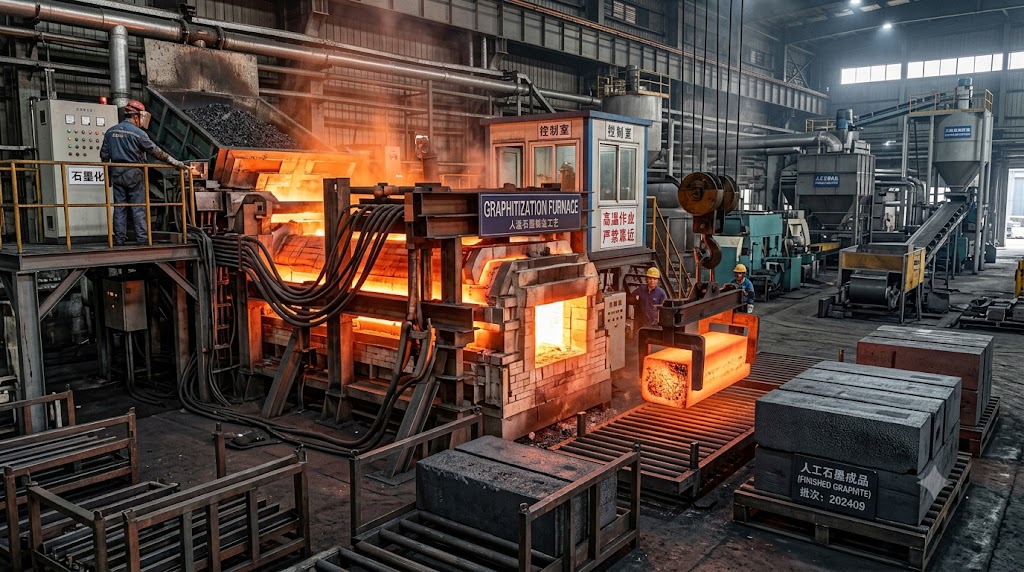
The production of graphite anode materials involves multiple processing stages. Although the specific manufacturing process differs between natural and artificial graphite, the main objective is to obtain high-purity graphite with optimized physical and electrochemical properties.
The typical manufacturing process of artificial graphite includes:
- Raw Material Selection: Petroleum coke or needle coke is selected according to the required performance specifications.
- Crushing and Grinding: Raw materials are processed into particles with a controlled size distribution.
- Granulation and Shaping: Particle morphology and packing characteristics are optimized.
- Carbonization: Carbon-rich precursors undergo thermal treatment to develop a suitable carbon structure.
- Graphitization: High-temperature treatment transforms the carbon structure into highly crystalline graphite.
- Surface Coating: Carbon coating can improve surface characteristics and help stabilize the electrode-electrolyte interface.
- Purification and Classification: Impurities are removed, and particles are classified according to customer specifications.
- Quality Inspection: Capacity, ICE, particle size distribution, compacted density, and other properties are evaluated.
Advanced manufacturing technologies are helping graphite material manufacturers improve production consistency, reduce energy consumption, and optimize electrochemical performance.
6. Development Trends of Graphite in Lithium Batteries
With the continuous advancement of lithium-ion battery technology, graphite anode materials are undergoing significant technological innovation. Several major development trends are shaping the future of graphite in lithium batteries.
6.1 High-Performance Graphite Anode Materials
The development of high-performance graphite anode materials is focused on increasing energy density, improving initial coulombic efficiency, and enhancing cycle life.
Through particle morphology optimization, surface modification, and advanced coating technologies, manufacturers can improve graphite’s electrochemical properties.
These improvements are particularly important for high-energy-density electric vehicle batteries and next-generation energy storage systems.
6.2 Fast-Charging Graphite Anodes
Fast charging is an important development direction for lithium-ion batteries. However, graphite anodes may experience lithium plating under high charging rates, particularly at low temperatures or when electrode transport is insufficient.
Lithium plating can reduce battery life and increase safety risks.
Researchers are developing strategies such as surface engineering, electrolyte optimization, particle structure modification, and electrode architecture optimization to improve fast-charging performance. Wiley Online Library+1
6.3 Silicon-Graphite Composite Anode Materials
Silicon has a much higher theoretical specific capacity than graphite, making it a promising material for increasing lithium-ion battery energy density.
However, silicon experiences significant volume expansion during lithiation and delithiation, which can lead to particle cracking and electrode degradation.
Silicon-graphite composite anode materials combine the high capacity of silicon with the structural stability and conductivity of graphite.
This approach is attracting considerable attention in high-energy-density lithium-ion batteries. Graphite is expected to remain an important component of these composite anode systems. Wiley Online Library+1
6.4 Sustainable Graphite Production and Recycling
Environmental sustainability is becoming increasingly important in the graphite anode industry.
Artificial graphite production can require substantial energy for graphitization, while natural graphite production involves mining, purification, and processing.
Future development is expected to focus on:
- Lower-energy graphitization technologies.
- Environmentally friendly graphite purification.
- Renewable carbon-based graphite precursors.
- Recycling graphite from spent lithium-ion batteries.
- Improving the carbon footprint of graphite anode manufacturing.
Recycled graphite has the potential to become an important secondary raw material, helping reduce resource consumption and support a circular battery supply chain. Nature Reviews Materials+1
7. Conclusion
Graphite remains one of the most important anode materials in the lithium-ion battery industry. Its excellent electrical conductivity, stable layered structure, relatively low operating potential, good cycle life, and mature manufacturing technology make it highly suitable for electric vehicles, consumer electronics, and energy storage systems.
Both natural graphite and artificial graphite play important roles in commercial battery applications. Natural graphite offers cost advantages, while artificial graphite provides greater control over material consistency and electrochemical properties.
As battery technology continues to advance, graphite anode materials are expected to evolve toward higher energy density, faster charging, longer cycle life, and improved environmental sustainability. Silicon-graphite composites, surface modification technologies, and graphite recycling will create new opportunities for the graphite anode industry.
For lithium-ion battery manufacturers, selecting high-quality graphite anode materials with appropriate specific capacity, initial coulombic efficiency, particle size distribution, and compacted density is essential for achieving reliable battery performance.
Graphite will continue to play a fundamental role in the development of advanced lithium-ion batteries and the global transition toward electrification and renewable energy storage