Professional graphite material supplier, graphite for EV, grease, furnace and any other industries.

Why Is Natural Graphite Becoming Increasingly Important?
Natural graphite is a naturally occurring crystalline carbon material and one of the most important non-metallic mineral resources in modern industries. Due to its unique layered structure, excellent electrical conductivity, high thermal stability, and outstanding lubricating properties, natural graphite is widely used in metallurgy, electronics, energy storage, aerospace, and other advanced manufacturing fields.
In recent years, the rapid development of electric vehicles, renewable energy storage systems, and consumer electronics has significantly increased the strategic value of natural graphite. In particular, natural graphite has become one of the key raw materials for lithium-ion battery anode materials, playing an important role in the global new energy supply chain.
So, what makes natural graphite valuable? How does it compare with synthetic graphite? And what role will it play in future energy technologies? This article provides a comprehensive overview of natural graphite, including its characteristics, processing technologies, and applications in lithium-ion batteries.
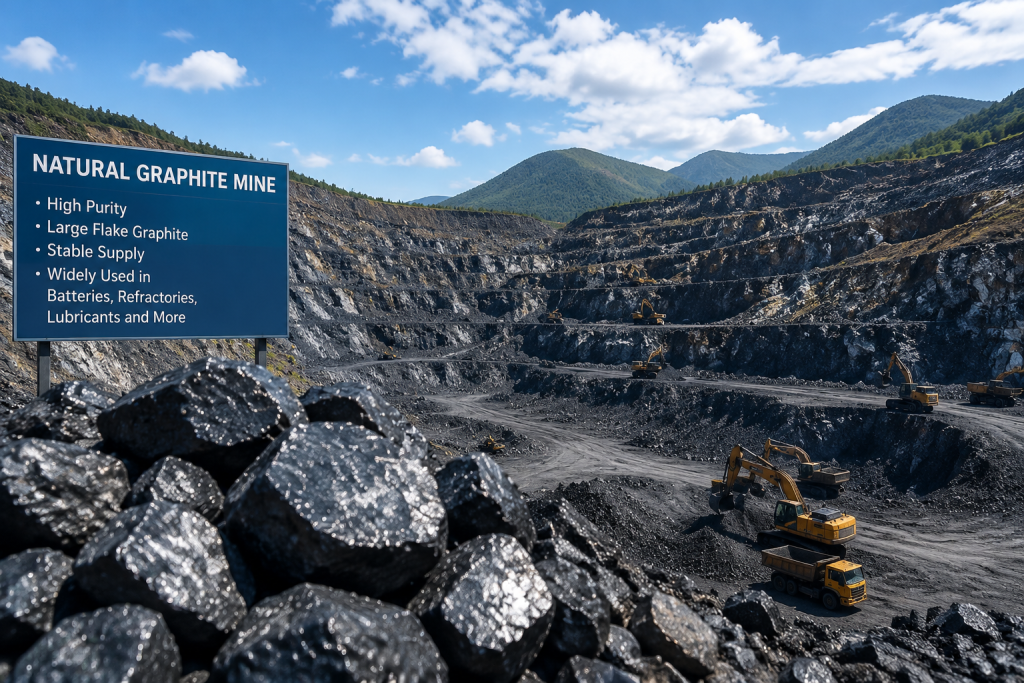
1. What Is Natural Graphite?
Natural graphite is a crystalline carbon material formed through geological processes over millions of years. During geological evolution, carbon-containing organic materials undergo high temperatures and pressures, gradually transforming into graphite.
Based on crystal structure and formation conditions, natural graphite is mainly classified into three types:
1. Flake Graphite
Flake graphite is the most widely used type of natural graphite in industrial applications. It features a layered structure, high carbon content, and excellent crystallinity.
Main applications include:
- Lithium-ion battery anode materials;
- Graphene production;
- Conductive materials;
- High-performance lubricants.
Due to its highly ordered layered structure, flake graphite has significant advantages in advanced energy applications.
2. Amorphous Graphite
Amorphous graphite has smaller crystal structures and generally lower carbon content compared with flake graphite.
It is mainly used in traditional industrial fields, including:
- Casting materials;
- Refractory products;
- Coatings and additives.
3. Vein Graphite
Vein graphite is a rare form of natural graphite with high purity and excellent physical properties. Due to its limited availability, it is mainly used in specialized high-end applications.
2. What Are the Advantages of Natural Graphite?
Natural graphite has become an important industrial material because of its unique physical and chemical properties.
1. Excellent Electrical Conductivity
The carbon atoms in graphite form a layered hexagonal crystal structure. Electrons can move freely within these layers, giving graphite excellent electrical conductivity.
This property makes natural graphite suitable for:
- Battery electrodes;
- Conductive coatings;
- Electrical components.
2. Outstanding High-Temperature Resistance
Natural graphite maintains structural stability under extremely high temperatures, making it widely used in:
- High-temperature furnaces;
- Graphite crucibles;
- Semiconductor thermal processing equipment.
3. Superior Lubricating Performance
The weak bonding between graphite layers allows them to slide easily against each other, providing natural lubrication properties.
Therefore, natural graphite is widely used in:
- Solid lubricants;
- Mechanical sealing materials;
- Industrial lubrication products.
3. Application of Natural Graphite in the Lithium-Ion Battery Industry
With the rapid expansion of electric vehicles, energy storage systems, and portable electronic devices, natural graphite has become one of the most important raw materials for lithium-ion battery anodes.
In lithium-ion batteries, the anode material stores and releases lithium ions during charging and discharging. Natural graphite is highly suitable for this application because its layered structure allows lithium ions to intercalate between graphite layers, enabling reversible energy storage.
The main advantages of natural graphite for lithium batteries include:
1. High Theoretical Capacity
Natural graphite has a theoretical specific capacity of approximately 372 mAh/g, making it capable of meeting the high energy density requirements of electric vehicles and consumer electronics.
2. Excellent Cycling Performance
After surface modification and structural optimization, natural graphite can achieve stable cycling performance and reduce material degradation during repeated charge and discharge processes.
3. Cost Advantages
Compared with many emerging anode materials, natural graphite has abundant resources, mature processing technologies, and relatively lower production costs.
Before being used in lithium-ion batteries, natural graphite typically undergoes several processing steps, including:
- Crushing and shaping;
- Particle classification;
- Purification;
- Surface coating;
- Carbonization treatment.
For example, pitch coating technology can improve the surface structure of natural graphite, reduce side reactions with electrolytes, and enhance initial coulombic efficiency.
As a result, modified natural graphite is widely used in:
- Electric vehicle power batteries;
- Energy storage batteries;
- High-performance consumer electronics batteries.
4. Natural Graphite vs. Synthetic Graphite
Although both natural graphite and synthetic graphite can be used as lithium-ion battery anode materials, they differ significantly in origin, structure, and performance.
| Comparison | Natural Graphite | Synthetic Graphite |
|---|---|---|
| Source | Natural mineral resources | Artificially produced from petroleum coke or needle coke |
| Crystal Structure | Naturally formed with high crystallinity | Produced through high-temperature graphitization |
| Cost | Relatively lower | Generally higher |
| Capacity | Higher theoretical capacity | More stable performance |
| Cycle Life | Requires modification | Usually better stability |
In practical battery manufacturing, companies often combine natural graphite, synthetic graphite, or composite graphite materials to achieve a balance between energy density, cycle life, safety, and cost.
5. Future Development Trends of Natural Graphite
As the global new energy industry continues to expand, demand for natural graphite is expected to remain strong.
Future development trends include:
1. Higher Purity Requirements
The battery and semiconductor industries require increasingly high graphite purity. High-purity natural graphite will become an important direction for future development.
2. Advanced Processing Technologies
Through technologies such as:
- Spherical graphite production;
- Surface coating;
- Structural modification;
Natural graphite performance can be further improved for advanced battery applications.
3. Green and Sustainable Production
With increasing global environmental requirements, graphite manufacturers are focusing on reducing energy consumption, improving resource efficiency, and developing cleaner production methods.
Natural Graphite Will Remain a Key Material in the New Energy Era
Natural graphite is no longer only a traditional industrial mineral. It has become a strategic material supporting the development of modern energy technologies.
From traditional applications such as refractory materials and lubricants to advanced uses in lithium-ion battery anodes, natural graphite continues to expand into new markets.
With continuous improvements in processing technology, purification methods, and surface modification techniques, high-performance natural graphite will continue to play a critical role in electric vehicles, energy storage systems, and the global transition toward clean energy
Graphite-Corp is an advanced materials manufacturer dedicated to the R&D, production, and sales of lithium-ion battery anode materials. Our current product portfolio includes artificial graphite anode materials, silicon-carbon and silicon-oxide anode materials, and porous carbon materials for silicon-carbon applications. Please feel free to contact us regarding your requirements; we look forward to serving you.
RELATED POSTS

Both Graphite And Diamond Is Made Of Carbon. Why Is Diamond Much Harder Than Graphite?
Expandable graphite can be used as a flame retardant and fireproof material – used for sealing strips of fire doors and fireproof glass windows

Thermophysical Properties of an EDM Graphite Electrode

Is Graphite Denser Than Diamond
