Professional graphite material supplier, graphite for EV, grease, furnace and any other industries.

With the rapid development of the global new energy industry, challenges such as rising lithium resource costs, supply chain risks, and uneven resource distribution have become increasingly significant. As an important alternative technology to lithium-ion batteries, sodium-ion batteries are attracting extensive attention due to their abundant sodium resources, lower cost, improved safety, and strong sustainability advantages.
Among all components of a sodium-ion battery, cathode materials are considered one of the most critical factors determining energy density, cycling performance, voltage characteristics, and manufacturing costs. Therefore, the development of high-performance sodium-ion battery cathode materials has become a key focus area for battery manufacturers and material researchers worldwide.
This article provides an in-depth analysis of sodium-ion battery cathode materials, including major technology routes, material advantages, current challenges, and future market opportunities.
1. The Importance of Sodium-ion Battery Cathode Materials
The working principle of sodium-ion batteries is similar to that of lithium-ion batteries. During charging, sodium ions (Na⁺) are extracted from the cathode material and migrate through the electrolyte to the anode. During discharge, sodium ions move back into the cathode structure while releasing electrical energy.
The cathode material plays a central role in storing and releasing sodium ions. Its properties directly influence:
- Battery energy density;
- Initial Coulombic efficiency;
- Cycle life;
- Rate capability;
- High and low-temperature performance;
- Overall manufacturing cost.
Compared with lithium ions, sodium ions have a larger ionic radius, which creates challenges in ion diffusion and structural stability. Therefore, optimizing cathode structures is essential for improving sodium-ion battery performance.
2. Major Technology Routes of Sodium-ion Battery Cathode Materials
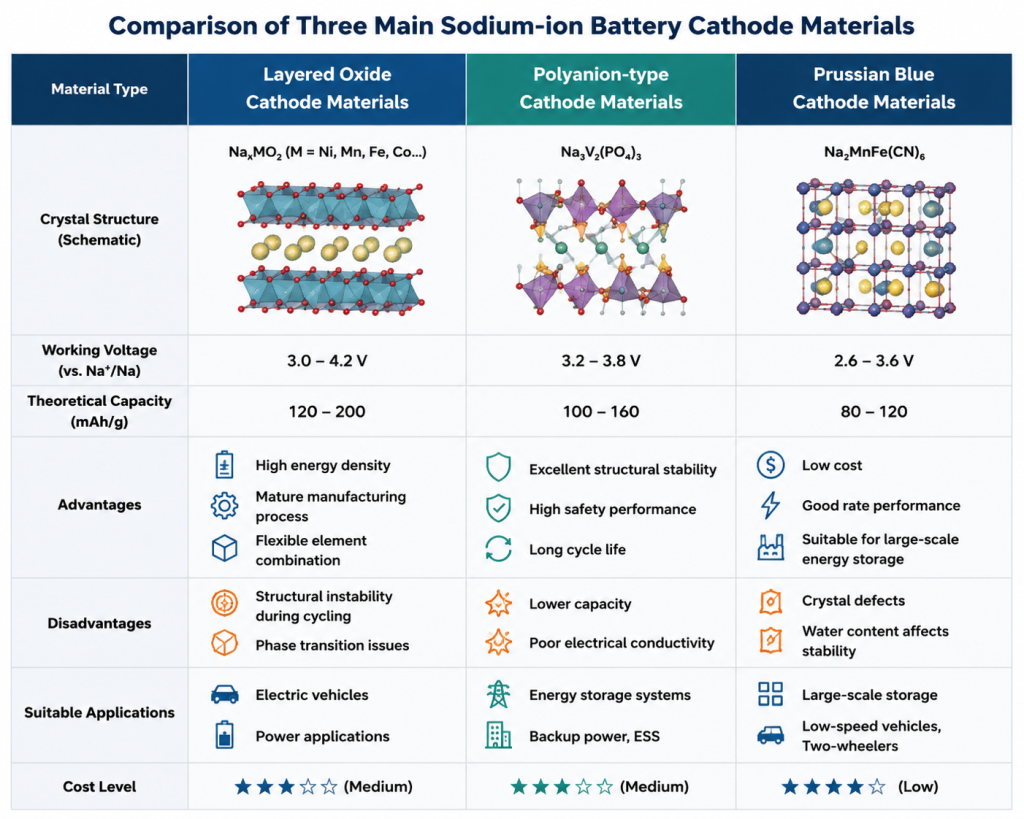
Currently, sodium-ion battery cathode materials mainly include three major categories:
- Layered oxide cathode materials;
- Polyanion-type cathode materials;
- Prussian blue and Prussian blue analog cathode materials.
Each material system has unique advantages in terms of energy density, stability, and cost competitiveness.
2.1 Layered Oxide Cathode Materials
Layered oxide materials are among the most widely studied cathode materials for sodium-ion batteries. Their structures are similar to those of layered lithium-ion battery cathodes.
The general chemical formula is:
NaₓMO₂
where M represents transition metals such as Ni, Mn, Fe, and Co.
By adjusting the ratio of different metal elements, researchers can optimize electrochemical performance.
Advantages of Layered Oxide Materials
(1) High Energy Density
Layered oxide cathodes generally have relatively high operating voltages, often exceeding 3V, allowing sodium-ion batteries to achieve higher energy density.
(2) Mature Manufacturing Process
The production process is similar to conventional lithium battery cathode manufacturing, including:
- Material mixing;
- High-temperature sintering;
- Particle processing;
- Surface coating.
This makes layered oxide materials easier to scale for commercial production.
(3) Flexible Element Selection
By combining different transition metals, manufacturers can balance performance, cost, and resource availability.
For example:
- Nickel-based materials improve capacity;
- Manganese-based materials reduce cost;
- Iron-based materials improve sustainability.
Current Challenges
Despite their advantages, layered oxide materials still face several challenges:
- Structural degradation during repeated sodium-ion insertion/extraction;
- Phase transformation during cycling;
- Increased interface side reactions.
Future improvements mainly focus on:
- Element doping;
- Surface coating;
- Crystal structure optimization.
3. Polyanion-type Cathode Materials: A Representative High-Safety Technology Route
Polyanion-type cathode materials mainly include:
- Na₃V₂(PO₄)₃;
- NaFePO₄;
- Na₃V₂(PO₄)₂F₃ (NVPF);
- Na₂FePO₄F.
These materials contain stable polyanion groups such as:
- PO₄³⁻;
- SO₄²⁻;
- F-containing structures.
Advantages of Polyanion Cathode Materials
1. Excellent Structural Stability
Strong covalent bonds within polyanion structures help maintain crystal stability during sodium-ion migration, resulting in excellent cycling performance.
2. Outstanding Safety Performance
Phosphate-based materials have high thermal stability and are less likely to release oxygen at elevated temperatures, reducing the risk of thermal runaway.
3. Long Cycle Life
Many polyanion materials can achieve thousands of charge-discharge cycles, making them suitable for:
- Grid-scale energy storage;
- Commercial and industrial energy storage systems;
- Backup power applications.
Limitations
The main challenges include:
- Lower theoretical capacity compared with layered oxide materials;
- Poor intrinsic electrical conductivity;
- Higher cost for some elements.
To overcome these issues, researchers are focusing on:
- Carbon coating;
- Nano-structure engineering;
- Conductive network optimization.
4. Prussian Blue Cathode Materials: A Low-cost Commercialization Path
Prussian blue analog materials (PBA) have attracted significant attention due to their low cost and excellent sodium storage capability.
Their open framework structure provides sufficient channels for sodium-ion migration.
Typical materials include:
- Na₂MnFe(CN)₆;
- Na₂FeFe(CN)₆.
Advantages of Prussian Blue Materials
(1) Low Material Cost
Prussian blue cathodes mainly use abundant elements such as iron and manganese, avoiding dependence on expensive metals like nickel and cobalt.
(2) Excellent Rate Performance
The open crystal framework enables rapid sodium-ion diffusion, providing good fast-charging capability.
(3) Suitable for Large-scale Energy Storage
Due to their cost advantages, Prussian blue cathode materials are considered promising candidates for large-scale sodium-ion energy storage applications.
Current Challenges
However, several issues remain:
- Crystal defects reduce capacity;
- Residual water molecules affect stability;
- Manufacturing process control is challenging.
Future research will focus on:
- Reducing structural defects;
- Improving synthesis processes;
- Enhancing long-term cycling stability.
5. Synergistic Development of Sodium-ion Cathodes and Anode Materials
The performance of sodium-ion batteries depends not only on cathode materials but also on advanced anode materials.
Currently, the most promising commercial sodium-ion anode material is:
Compared with graphite, hard carbon has:
- Larger interlayer spacing;
- More defect sites;
- Abundant sodium storage sites.
These characteristics allow efficient sodium-ion storage.
The next generation of high-performance sodium-ion batteries requires the combination of:
High-performance cathode materials + high-efficiency hard carbon anodes + optimized electrolyte systems
to achieve better overall battery performance.
6. Future Development Trends of Sodium-ion Battery Cathode Materials
With increasing commercialization, sodium-ion battery cathode materials are expected to develop in several key directions.
1. Lower Cost Manufacturing
Cost reduction remains the most important factor for sodium-ion battery adoption.
Future development will focus on:
- Iron-based cathode materials;
- Manganese-based cathode materials;
- Abundant resource utilization.
2. Higher Energy Density
Researchers are working on:
- Element doping;
- Structural modification;
- Surface engineering;
to increase capacity and operating voltage.
3. Sustainable and Environmentally Friendly Production
Future cathode materials will reduce dependence on:
- Cobalt;
- Nickel;
- Other expensive metals.
This will support greener and more sustainable battery supply chains.
4. Expansion of Sodium-ion Battery Applications
Sodium-ion batteries are expected to grow rapidly in:
- Renewable energy storage systems;
- Electric two-wheelers;
- Low-speed electric vehicles;
- Industrial and commercial energy storage.
7. Conclusion
Sodium-ion battery cathode materials are the core technology determining the future development of sodium-ion energy storage systems. Currently, layered oxide materials, polyanion compounds, and Prussian blue cathode materials represent the three major technical pathways.
Among them:
- Layered oxide cathode materials provide higher energy density and are suitable for power applications;
- Polyanion cathode materials offer excellent safety and long cycle life, making them ideal for energy storage systems;
- Prussian blue cathode materials provide outstanding cost advantages and strong commercialization potential.
With continuous improvements in cathode materials, hard carbon anodes, electrolytes, and manufacturing technologies, sodium-ion batteries are expected to become an important complement to lithium-ion batteries and play a significant role in the global new energy industry.
RELATED POSTS

where is graphite found
What is the difference between a battery and a lithium battery?

where do you find graphite
Is Graphite Ionic Covalent Or Metallic

2020 Annual Report on Natural Flake Graphite Industry Research