Professional graphite material supplier, graphite for EV, grease, furnace and any other industries.


(Graphite Purity and Graphite Applications)
As the world enters the carbon era, graphite’s unique physical characteristics provide it with tremendous industrial value. High-purity graphite is a vital raw material for advanced technological applications, such as foils & films, graphite composites, and special lubricants. Graphite is also an essential ingredient in the lithium-ion batteries that power modern devices such as smartphones/tablets/PCs. With improved efficiency and longer power back-ups, innovations in lithium ion battery technology are driving market growth across a variety of end-use industries.
While the price of graphite concentrate has come off its recent highs, some producers listed on western exchanges are sounding the alarm about an impending supply gap. However, unlike lithium, the majority of natural and synthetic graphite production is located in Asia, where the demand picture is more promising.
Graphite mines crush and grind ore to separate flakes, which typically have a purity of at least 94 percent. These flakes are then sorted by size to produce jumbo, large, medium and fine flake graphite, with each type having different applications. Graphite powders are used for crucibles, foundry facings, pencils (including the “lead” in common pencils), zinc-carbon batteries and other specialized applications.
To ensure future supply, buyers can consider long-term contracts with a diverse mix of suppliers. Ideally, these contracts should include established commodity aggregators as well as some mines and processing facilities. This will help ensure a consistent source of quality graphite even in times of tight supply. Buyers can also segment potential suppliers by geography and political risk. For example, new, vertically integrated suppliers in Turkey and Brazil are opening soon, and their expansion plans need to be taken into account.
In addition to its traditional applications in refractories, lubricants, pencils, and industrial materials, graphite has become one of the most critical raw materials in the modern lithium-ion battery industry. With the rapid growth of electric vehicles, renewable energy storage, and portable electronic devices, the demand for battery-grade graphite has increased significantly. Today, graphite is the primary anode material used in commercial lithium-ion batteries, playing an essential role in determining battery performance, energy density, safety, and service life.
The reason graphite is widely used in lithium-ion batteries is closely related to its unique layered crystal structure. Graphite consists of stacked graphene layers, allowing lithium ions to be inserted and removed reversibly during battery charging and discharging. During charging, lithium ions move from the cathode through the electrolyte and enter the graphite layers, forming lithium graphite compounds. During discharge, these lithium ions return to the cathode, releasing electrical energy. This reversible process provides graphite anodes with excellent electrochemical stability, high charging efficiency, and long cycle performance.
Battery-grade graphite requires much higher purity and stricter quality control compared with traditional industrial graphite products. While natural graphite flakes used in conventional industries may have purities around 94% or higher after processing, lithium-ion battery applications typically require graphite purity levels above 99.95%. To achieve this standard, graphite undergoes additional processing steps, including chemical purification, thermal treatment, spheroidization, and surface coating. These processes improve graphite particle structure, enhance lithium-ion diffusion, and reduce unwanted reactions inside the battery.
Currently, graphite anode materials used in lithium-ion batteries mainly include natural graphite and synthetic graphite. Natural graphite is produced from high-quality flake graphite resources and processed into spherical graphite. It offers advantages such as high crystallinity, excellent lithium storage capacity, and lower production costs. Synthetic graphite is manufactured from carbon materials such as petroleum coke and needle coke through high-temperature graphitization. Although synthetic graphite production requires more energy, it provides better structural consistency, higher cycle stability, and improved performance under high-power operating conditions. Therefore, synthetic graphite is widely used in electric vehicle batteries and large-scale energy storage systems.
The expansion of the electric vehicle market has become one of the strongest drivers for graphite demand. Modern electric vehicles require batteries with higher energy density, faster charging capability, and longer service life. To meet these requirements, graphite manufacturers are continuously developing advanced anode technologies. Improvements such as smaller and more uniform particle sizes, surface coatings, optimized pore structures, and carbon composite designs help improve lithium-ion transport efficiency and reduce capacity loss during repeated charging cycles.
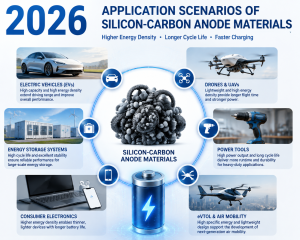
One of the most promising development trends is the combination of graphite with silicon-based materials to create silicon-carbon composite anodes. Although graphite provides excellent stability, its theoretical capacity is limited to approximately 372 mAh/g. Silicon has a much higher theoretical capacity, but its large volume expansion during lithium insertion and extraction can damage the electrode structure. By integrating silicon materials with graphite, researchers aim to achieve higher energy density while maintaining the long cycle life and reliability of graphite. Silicon-carbon graphite composite anodes are expected to become an important technology for future high-energy lithium-ion batteries.
The global graphite supply chain is also becoming increasingly important for battery manufacturers. Since China currently plays a major role in graphite processing and battery-grade graphite production, many countries and companies are seeking to diversify supply sources to reduce supply chain risks. New graphite mining and processing projects in regions such as Africa, South America, and other resource-rich areas are being developed to provide additional sources of battery-grade graphite. Vertical integration, where companies control both mining and processing operations, is becoming an important strategy to ensure stable supply and consistent product quality.
Sustainability has also become a key focus in the graphite industry. As battery demand continues to increase, reducing the environmental impact of graphite extraction and processing has become a priority. Companies are exploring cleaner purification technologies, renewable energy use in production, and recycling methods for recovering graphite from used lithium-ion batteries. Battery recycling is expected to become an important source of secondary graphite materials, helping reduce dependence on natural resources and supporting a more sustainable battery ecosystem.
Looking ahead, graphite will remain a fundamental material in the lithium-ion battery industry. Although emerging anode materials such as silicon, lithium metal, and hard carbon are attracting significant research interest, graphite continues to offer the best combination of cost, performance, safety, and commercial maturity. Continuous innovation in natural graphite processing, synthetic graphite manufacturing, and graphite-based composite materials will further improve battery technology.
As the global transition toward electrification and renewable energy accelerates, graphite will continue to serve as a strategic resource for energy storage technologies. From electric vehicles and consumer electronics to grid-scale energy storage systems, advanced graphite anode materials will play a vital role in supporting the future development of clean energy solutions. The evolution of graphite from a traditional mineral resource into a high-value battery material highlights its growing importance in the global energy transition.
Graphite-Corp is an advanced materials manufacturer dedicated to the R&D, production, and sales of lithium-ion battery anode materials. Our current product portfolio includes artificial graphite anode materials, silicon-carbon and silicon-oxide anode materials, and porous carbon materials for silicon-carbon applications. Please feel free to contact us regarding your requirements; we look forward to serving you.

(Graphite Purity and Graphite Applications)
RELATED POSTS
CVD-Coated Silicon-Carbon Materials: Advanced Anode Materials for Lithium-Ion Batteries

What are basic structure and properties of graphite?
Application Prospects Of Hard Carbon In Zinc-Ion Batteries

Who Mines Graphite
Comprehensive Material Solutions for Batteries in Extreme Cold Regions
