Professional graphite material supplier, graphite for EV, grease, furnace and any other industries.

As the global demand for renewable energy, electric transportation, and energy storage continues to grow, battery technology is entering a new stage of development. Lithium-ion batteries remain the dominant rechargeable battery technology, but concerns about raw material costs, resource availability, and supply chain security have encouraged researchers and manufacturers to explore alternative battery chemistries. Among these alternatives, sodium-ion batteries have attracted increasing attention because of their abundant raw materials, cost potential, and suitability for large-scale energy storage.
This article explores the major applications and development of sodium-ion batteries, with a particular focus on sodium-ion battery materials, energy storage, electric mobility, and future commercialization.
What Are Sodium-ion Batteries?
A sodium-ion battery is a rechargeable battery that stores and releases electrical energy through the movement of sodium ions between the cathode and anode. Its working principle is similar to that of a lithium-ion battery, but sodium ions replace lithium ions as the charge carriers.
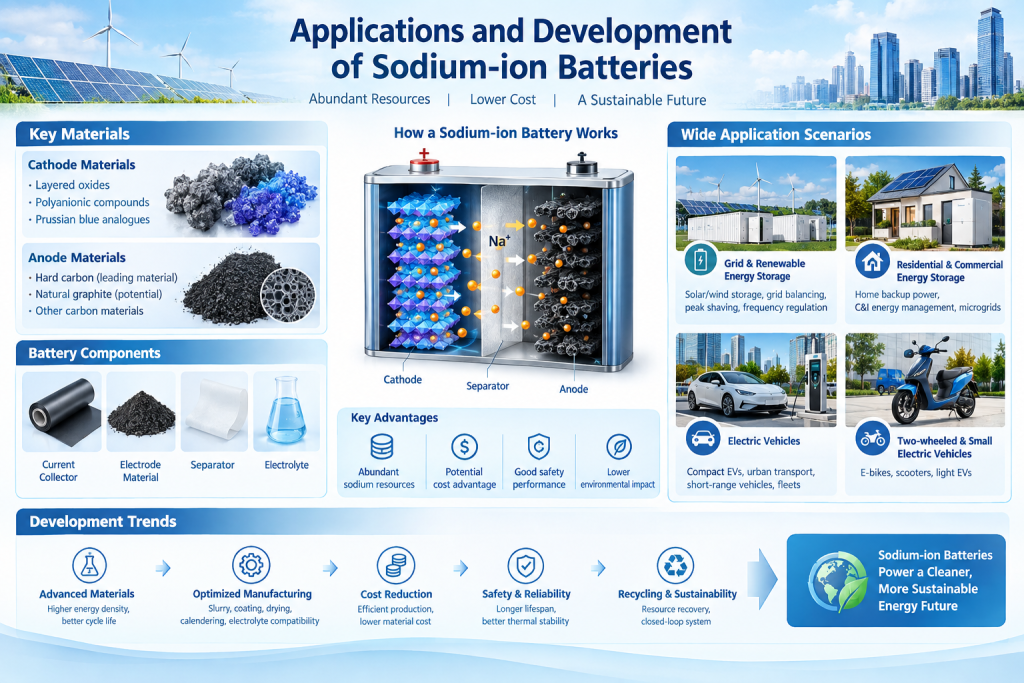
A typical sodium-ion battery consists of a cathode, anode, electrolyte, separator, and current collectors. Depending on the battery chemistry, cathode materials can include layered oxide materials, polyanionic compounds, and Prussian blue or Prussian white analogues. Hard carbon is currently one of the most important anode materials for sodium-ion batteries because it offers suitable sodium-storage behavior and practical electrochemical performance.
One of the major advantages of sodium-ion battery technology is the abundance of sodium resources. Sodium is widely distributed around the world and is not subject to the same resource constraints as lithium. This characteristic creates opportunities for reducing dependence on critical battery minerals.
Key Sodium-ion Battery Materials
The development of sodium-ion batteries is closely connected with improvements in cathode and anode materials.
Hard Carbon Anode
Hard carbon is considered a leading anode material for commercial sodium-ion batteries. Unlike graphite, which has limited sodium-storage capability under conventional conditions, hard carbon can provide suitable reversible sodium-ion storage.
Important performance indicators for hard carbon anodes include specific capacity, initial Coulombic efficiency, rate capability, cycle life, tap density, particle size distribution, and processing performance.
The selection of carbon precursors and optimization of carbonization temperature, pore structure, surface chemistry, and particle morphology can significantly influence the final electrochemical performance.
Sodium-ion Cathode Materials
Cathode materials are another critical part of sodium-ion battery development. Common material families include layered transition-metal oxides, polyanionic compounds, and Prussian blue analogues.
Different cathode systems offer different combinations of energy density, cycle life, cost, thermal stability, and processing requirements. Therefore, the choice of cathode material depends strongly on the intended application.
Applications of Sodium-ion Batteries
The potential applications of sodium-ion batteries cover energy storage, electric mobility, low-speed transportation, and other power applications.
1. Grid and Renewable Energy Storage
Large-scale energy storage is one of the most promising applications for sodium-ion batteries. Solar and wind power generation are intermittent, creating a need for batteries that can store electricity and release it when required.
Sodium-ion batteries may be suitable for stationary energy storage systems because their chemistry can take advantage of abundant and potentially lower-cost raw materials. Potential applications include solar-plus-storage systems, wind energy storage, grid balancing, peak shaving, and frequency regulation.
2. Residential and Commercial Energy Storage
Sodium-ion batteries can also be considered for residential energy storage and commercial and industrial energy storage systems.
For households, a sodium-ion battery energy storage system can store electricity generated by rooftop solar panels and provide power during periods of high electricity demand or grid interruptions.
For commercial and industrial users, sodium-ion battery systems may be used for peak-valley electricity management, backup power, renewable energy integration, and microgrid applications.
3. Electric Vehicles
Electric vehicles represent another potential application for sodium-ion battery technology. Although sodium-ion batteries generally have lower energy density than some advanced lithium-ion battery systems, their potential cost advantages and resource availability may make them attractive for specific vehicle segments.
Possible applications include compact electric vehicles, urban transportation, short-range passenger vehicles, commercial vehicles, and electric fleets where extremely high energy density is not the primary requirement.
Sodium-ion batteries may also be used together with lithium-ion battery systems in hybrid battery architectures, allowing manufacturers to balance cost, power, energy density, and operating requirements.
4. Two-wheeled and Small Electric Vehicles
Electric bicycles, scooters, and other two-wheeled vehicles have specific requirements for cost, safety, cycle life, and operating temperature.
Sodium-ion battery technology may provide another solution for these markets. In particular, continued development of hard carbon anode materials for sodium-ion batteries could improve energy density and cycling performance while maintaining the cost advantages associated with sodium-based chemistry.
Development Trends of Sodium-ion Batteries
The development of sodium-ion batteries is moving from laboratory research toward pilot production and commercial-scale applications. Several technical directions are particularly important.
First, manufacturers are working to improve the energy density of sodium-ion cells through advanced cathode and anode materials. Increasing the specific capacity and initial Coulombic efficiency of hard carbon is an important research direction.
Second, electrode manufacturing processes are being optimized. Slurry formulation, coating uniformity, electrode density, porosity, drying, calendering, and electrolyte compatibility all influence final cell performance.
Third, battery manufacturers are paying greater attention to the total cost of ownership. The competitiveness of sodium-ion batteries will depend not only on material prices but also on manufacturing efficiency, battery lifespan, safety, recycling, and system integration.
Sodium-ion Batteries vs. Lithium-ion Batteries
Sodium-ion and lithium-ion batteries are not necessarily direct replacements for one another in every application. Instead, they can serve different market requirements.
Lithium-ion batteries currently provide advantages in areas where high energy density and mature supply chains are critical. Sodium-ion batteries may provide advantages in applications where material availability, cost, safety characteristics, low-temperature performance, or stationary storage requirements are particularly important.
Future battery markets are therefore likely to include multiple technologies rather than relying on a single battery chemistry.
Future Outlook for Sodium-ion Battery Technology
The future development of sodium-ion batteries will depend on improvements across the entire battery value chain, including raw materials, electrode materials, cell manufacturing, battery management systems, and recycling.
For material suppliers, developing high-performance hard carbon anode materials, advanced sodium-ion cathode materials, conductive materials, and other functional components will be essential for improving cell performance.
As production technologies mature, sodium-ion batteries could gradually expand into renewable energy storage, residential energy storage, commercial energy storage, electric mobility, and other cost-sensitive applications.
Conclusion
The applications and development of sodium-ion batteries are attracting growing attention as the battery industry seeks more diversified and sustainable energy-storage technologies. Their advantages in sodium resource availability and potential cost competitiveness make them particularly interesting for stationary energy storage and selected electric mobility applications.
At the same time, challenges such as energy density, initial Coulombic efficiency, material performance, manufacturing processes, and large-scale commercialization still require continuous technological development.
With advances in hard carbon anode materials, sodium-ion cathode materials, electrode manufacturing, and cell engineering, sodium-ion batteries are expected to become an increasingly important part of the next generation of rechargeable energy-storage technologies.
RELATED POSTS
What Is The Definition Of Graphite
Thermodynamic Insight: What Is the Standard Gibbs Free Energy for the Transformation of Diamond to Graphite at 298 K?

Application of flake graphite in lithium battery

Waxed Wonder: Investigating the Safety Concerns Surrounding Graphite Wax.

Artistic Techniques: How to Draw and Shade with Graphite and Charcoal
