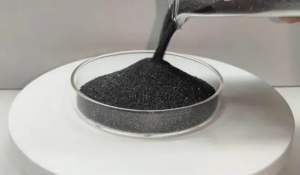
Профессиональ графит материалы менән тәьмин итеүсе, графит өсөн Э.В., майлау, мейес һәм башҡа теләһә ниндәй тармаҡтар.

Кремний-углерод анод материалдары: The Next Generation High-Energy-Density Solution
As the demand for high-energy-density lithium-ion batteries continues to grow in electric vehicles (ЭВС), energy storage systems, and consumer electronics, silicon-carbon anode materials have become one of the most promising next-generation anode technologies. Compared with traditional graphite anodes, silicon offers an ultra-high theoretical specific capacity of approximately 4,200 мАч/г, nearly ten times that of graphite (372 мАч/г). Әммә, severe volume expansion during charge-discharge cycling remains a major challenge. To overcome this issue, researchers have developed silicon-carbon composite anodes through advanced material engineering and manufacturing processes.
Main Preparation Processes of Silicon-Carbon Anode Materials
1. Mechanical Ball Milling Method
Mechanical ball milling is one of the most widely used methods for preparing silicon-carbon composites. Silicon powder and carbon materials are uniformly mixed through high-energy ball milling, forming a stable composite structure.
Өҫтөнлөктәре:
- Simple production process
- Low manufacturing cost
- Suitable for large-scale industrial production
Disadvantages:
- Limited control over particle morphology
- Potential damage to material structure during milling
2. Химик пар менән ултыртыу (Йөрәк-йөрәк ауырыуы)
Химик пар менән ултыртыу (Йөрәк-йөрәк ауырыуы) is an advanced technology used to coat silicon particles with a uniform carbon layer. Hydrocarbon gases decompose at high temperatures, forming conductive carbon coatings on the silicon surface.
Өҫтөнлөктәре:
- Excellent carbon coating uniformity
- Improved electrical conductivity
- Enhanced cycle stability
Disadvantages:
- High equipment investment
- Complex production process
3. Sol-Gel Method
The sol-gel process enables nano-scale dispersion of silicon particles within a carbon precursor matrix. After drying and carbonization, a porous silicon-carbon composite structure is obtained.
Өҫтөнлөктәре:
- Precise control of particle size
- Uniform composite distribution
- Improved structural stability
Disadvantages:
- Relatively high production cost
- Longer processing cycle
4. Spray Drying Technology
Spray drying has become a mainstream industrial production route for silicon-carbon anodes. Кремний нанокиҫәксәләре, графит, binders, and carbon precursors are dispersed into a slurry and atomized into spherical particles before carbonization.
Өҫтөнлөктәре:
- High production efficiency
- Excellent particle consistency
- Suitable for large-scale battery manufacturing
5. Pyrolysis Carbon Coating Process
Был ысулда ., organic carbon sources such as pitch, resin, or polymers are coated onto silicon particles and subsequently carbonized under an inert atmosphere to form a protective carbon shell.
The resulting carbon layer effectively buffers silicon volume expansion and enhances electrode conductivity, making it one of the most commercially viable technologies today.
Future Development Trends
Current research focuses on nano-silicon technology, porous silicon structures, yolk-shell architectures, and graphene-coated silicon-carbon composites. These innovations aim to further improve cycle life, initial coulombic efficiency, and fast-charging performance.
With the rapid development of electric vehicles and AI-driven energy storage systems, silicon-carbon anode materials are expected to gradually replace traditional graphite anodes and become a key technology for next-generation high-performance lithium-ion batteries.
Һығымта
The preparation process plays a decisive role in the performance of silicon-carbon anode materials. Technologies such as ball milling, Йөрәк-йөрәк ауырыуы, sol-gel synthesis, spray drying, and pyrolysis carbon coating each offer unique advantages for balancing capacity, тотороҡлолоҡ, and production cost. As manufacturing technologies continue to mature, silicon-carbon anodes will accelerate the commercialization of high-energy-density lithium-ion batteries worldwide.