Professional graphite material supplier, graphite for EV, grease, furnace and any other industries.

Silicon, as a next-generation anode material for lithium-ion batteries, has a theoretical specific capacity of 4200 mAh/g.
However, its volume expands by over 300% after lithium intercalation, leading to particle pulverization, repeated cracking of the SEI film, and ultimately rapid battery capacity degradation. Porous carbon acts as the core “buffer framework” in silicon-carbon anodes, playing a crucial role in encapsulating silicon particles, dispersing expansion stress, and building a conductive network. However, even among porous carbons, differences in structural design directly determine their resistance to expansion and even affect the cycle life of the silicon-carbon anode.
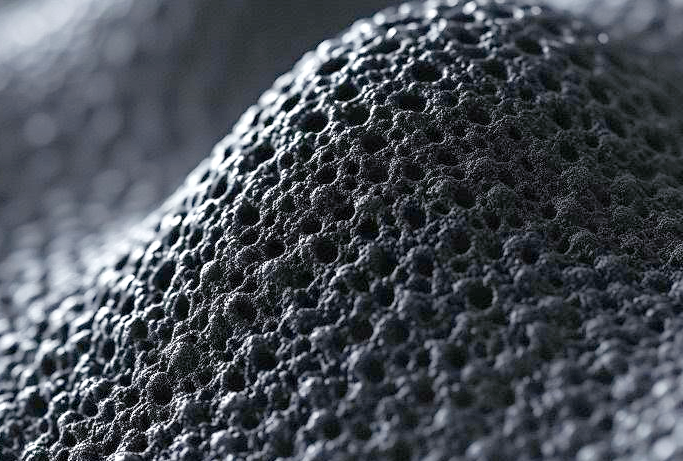
First, let’s understand: the “failure mechanism” of porous carbon’s inability to withstand silicon expansion.
The fracturing of porous carbon in silicon-carbon anodes is not caused by a single factor, but rather by the combined effect of inherent defects in the carbon framework and the stress impact from silicon expansion.
Insufficient skeletal strength to withstand cyclic stress: Porous carbon prepared from conventional carbon sources, such as resin-based materials, will experience localized stress concentration due to molecular chain breakage during pyrolysis, forming microcracks. At low temperatures, the carbon skeleton becomes even more fragile, and the physical constraints decrease significantly. During the repeated expansion and contraction of silicon, these cracks will propagate rapidly until the skeleton collapses.
The pore design is unreasonable, lacking sufficient expansion-buffering space. If the proportion of micropores in the porous carbon is too low and the pore size distribution is irregular, it cannot provide a uniform “support space” for the silicon particles, nor does it reserve sufficient expansion space. After lithium intercalation into silicon, the silicon will directly compress the carbon walls, leading to the rupture of the porous carbon structure. At the same time, the silicon particles will be exposed and undergo side reactions with the electrolyte.
Weak interfacial bonding between silicon and carbon triggers a chain reaction: the lack of effective bonding between the porous carbon and silicon particles leads to delamination of silicon from the carbon framework during silicon expansion. This not only disrupts the conductive network but also exposes fresh silicon surfaces, leading to repeated formation and rupture of the SEI film. The thickened SEI film then hinders lithium-ion transport, further exacerbating electrode failure.
The “three key design principles” of expansion-resistant porous carbon.
(I) Precise pore structure
Pores are fundamental to the expansion buffering of silicon in porous carbon. The design of high-quality porous carbon requires meeting three key requirements: “high proportion of micropores + reasonable pore size distribution + connectivity,” rather than simply pursuing high porosity.
- A key factor is that micropores (with a pore size of <3 nm) account for over 85%, which improves silicon loading efficiency and, at the same time, fixes the silicon particles through “spatial confinement,” preventing their aggregation and compaction;
- The pore size needs to be matched to the size of the silicon nanoparticles, allowing the silicon to uniformly fill the pores rather than randomly depositing and forming “floating silicon” particles.
- The pores need to form a three-dimensional interconnected network, which can both disperse the local stress caused by silicon expansion and provide channels for lithium ion transport, thus preventing carbon wall rupture due to stress concentration.
(II) High-strength and high-toughness carbon framework
The porosity of porous carbon is inversely proportional to its mechanical strength. The core of anti-expansion design is to find a balance between high porosity and high mechanical strength, avoiding the “porous but fragile” problem.
- Optimizing carbon sources and preparation processes: For example, by using synergistic cross-linking of phenolic hydroxyl-containing aromatic aldehydes and dialdehyde polyethylene glycol, high-strength and high-toughness phenolic resins can be prepared. The resulting porous carbon after carbonization is free of microcracks, and its compressive strength is significantly improved.
- Introducing external reinforcing structures: A vertical array of carbon nanotubes/graphene is constructed on the surface of porous carbon. Utilizing the ultra-high tensile strength of carbon nanotubes (200 GPa), a “steel reinforcement framework” is formed, dispersing expansion stress and increasing the compressive strength of the silicon-carbon composite material by more than 50%.
- Controlling the crystallinity of the framework: This avoids the formation of a large number of disordered graphite microcrystals, reduces stress defects within the framework, and improves structural stability during cycling.
(III) Stable interface design
The interfacial bonding force between silicon and porous carbon determines whether they will delaminate during cycling. A high-quality interface design can fundamentally prevent structural fracture caused by separation.
- Surface coating with amorphous carbon layer: An amorphous carbon layer of 10-50 nm is coated on the surface of the porous carbon framework, preventing direct contact between the electrolyte and silicon, while simultaneously restricting the expansion direction of the silicon particles and enhancing the silicon-carbon interface bonding.
- Introducing functional groups/interlayers: Using fluorine-containing carbon sources such as PVDF, fluorine atoms are embedded into the Si-Si bonds to enhance interfacial bonding; or introducing an SiO₂ interlayer between silicon and carbon to buffer stress while simultaneously forming Li₄SiO₄, further stabilizing the interface;
- Adaptation for SEI film formation: The surface properties of porous carbon need to promote the formation of a stable SEI film (such as a fluoropolymer SEI) to prevent continuous electrolyte decomposition after SEI film rupture, which would exacerbate the corrosion and fragmentation of the porous carbon.
In summary, the fundamental differences in the carbon source materials of porous carbon materials are the core reason for the significant variations in their resistance to silicon expansion. Currently, the mainstream pitch-based, coconut shell-based, and lignin-based porous carbons used in lithium-ion batteries exhibit distinct differences in their suitability for silicon-carbon anode systems due to variations in their microscopic skeletal structure, pore morphology, and surface chemical properties, which directly determine their differing abilities to resist silicon expansion.